
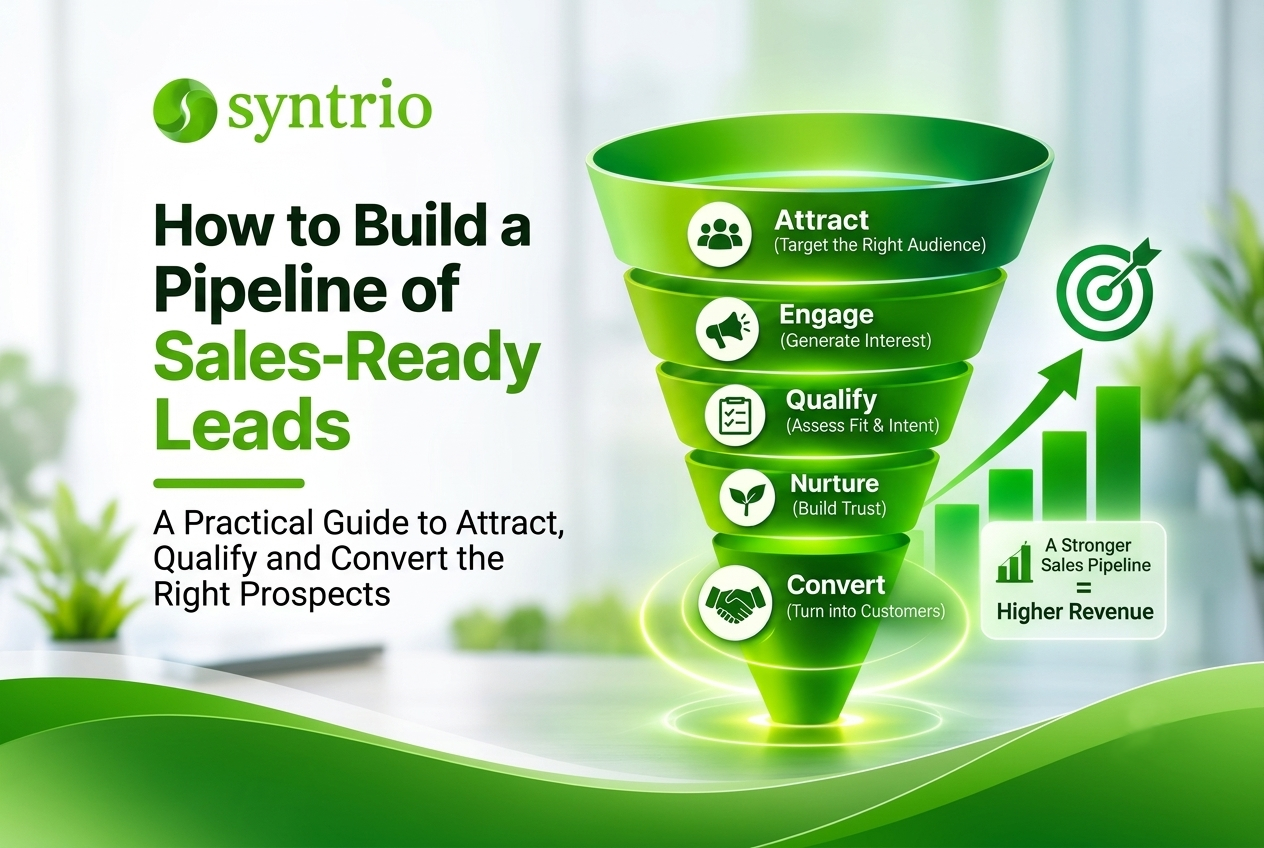
Introduction: Why Lead Quality Matters More Than Lead Quantity
Generating leads is an important part of business growth, but generating the right leads is what drives revenue. Many businesses invest in digital marketing, paid advertising, email campaigns and outbound sales activities to attract potential customers. However, a high number of enquiries does not necessarily translate into more sales.
One of the biggest challenges sales teams face is spending valuable time pursuing prospects who have little buying intent, lack decision-making authority or are simply not ready to make a purchase. This creates longer sales cycles, lower conversion rates and unnecessary pressure on sales resources.
This is where sales-ready leads become important.
A sales-ready lead is a potential customer who has been identified and qualified based on relevant business requirements, buying intent, budget, decision-making authority and readiness to engage with a sales team. Instead of focusing only on the number of leads generated, businesses can concentrate on prospects with a stronger likelihood of conversion.
Building a consistent pipeline of sales-ready leads requires a structured approach that combines the right audience targeting, accurate prospect data, effective lead qualification, timely engagement and continuous follow-ups.
In this guide, we explore what makes a lead sales-ready, how to identify high-quality prospects, and the strategies businesses can use to build a predictable sales pipeline that supports stronger conversions and sustainable growth.
2. What Are Sales-Ready Leads?
Sales-ready leads are potential customers who have demonstrated a genuine interest in a product or service and meet the key criteria required for a meaningful sales conversation. These prospects have been researched, evaluated and qualified to determine whether they are a good fit for a business’s offerings.
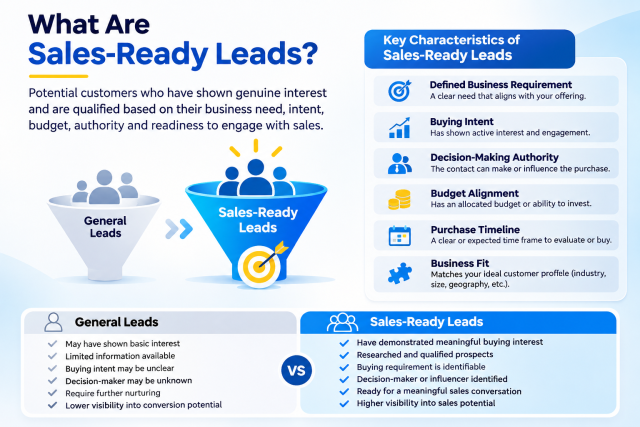
Unlike general leads generated through website enquiries, advertising campaigns or contact databases, sales-ready leads go through an additional qualification process. This helps businesses identify prospects who have a relevant business requirement, the ability to make or influence purchasing decisions, and a reasonable likelihood of moving forward.
For example, consider a company offering cloud infrastructure management services. A business that simply downloads a cloud services brochure may be considered an initial lead. However, a company actively looking to migrate its infrastructure, reduce cloud costs or improve security, with an identified decision-maker and a defined requirement, represents a much stronger sales opportunity.
Key characteristics of sales-ready leads include:
- Defined Business Requirement: The prospect has an identifiable need that aligns with the products or services being offered.
- Buying Intent: The prospect has shown interest through enquiries, discussions, website activity or direct engagement.
- Decision-Making Authority: The contact is a decision-maker or has direct influence over the purchasing process.
- Budget Alignment: The prospect has an allocated budget or a realistic ability to invest.
- Purchase Timeline: There is a clear indication of when the prospect intends to evaluate or purchase a solution.
- Business Fit: The organisation matches the company’s ideal customer profile in terms of industry, size, geography and requirements.
Sales-Ready Leads vs General Leads
The fundamental difference lies in the level of qualification and purchase readiness.
| General Leads | Sales-Ready Leads |
|---|---|
| May have shown basic interest | Have demonstrated meaningful buying interest |
| Limited information available | Researched and qualified prospects |
| Buying intent may be unclear | Buying requirement is identifiable |
| Decision-maker may be unknown | Decision-maker or influencer identified |
| Require further nurturing | Ready for a meaningful sales conversation |
| Lower visibility into conversion potential | Higher visibility into sales potential |
It is important to understand that a sales-ready lead is not necessarily a guaranteed customer. It is a prospect who has met the qualification criteria and is ready for direct engagement with the sales team.
The objective is simple: Move beyond collecting contacts and start identifying genuine business opportunities.
3. MQL vs. SQL vs. Sales-Ready Leads: What’s the Difference?
Not every lead generated through marketing is ready for a sales conversation. Prospects move through different stages of the buying journey, and understanding these stages helps businesses allocate their marketing and sales resources more effectively.
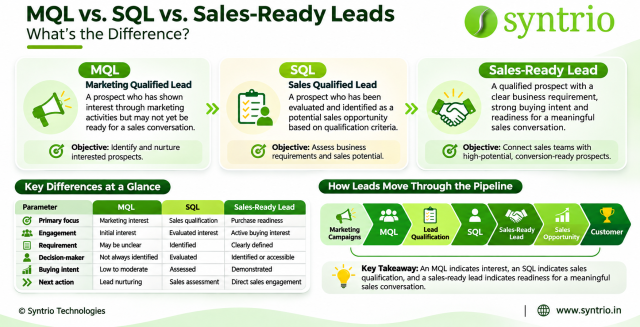
Three commonly used terms in B2B lead management are Marketing Qualified Leads (MQLs), Sales Qualified Leads (SQLs) and Sales-Ready Leads.
1. Marketing Qualified Leads (MQLs)
A Marketing Qualified Lead is a prospect who has shown interest in a company’s products or services through marketing activities but may not yet be ready to speak with the sales team.
For example, someone who downloads an eBook, subscribes to a newsletter, attends a webinar or engages with a marketing campaign may qualify as an MQL.
The objective: Identify interested prospects and nurture them through relevant content, communication and engagement.
2. Sales Qualified Leads (SQLs)
A Sales Qualified Lead is a prospect who has been evaluated and identified as a potential sales opportunity based on predefined qualification criteria.
At this stage, the prospect’s business requirements, potential interest, decision-making role and purchasing possibilities have been assessed. The lead is considered suitable for direct sales engagement.
The objective: Identify prospects with a genuine business requirement and determine whether they can move forward in the sales process.
3. Sales-Ready Leads
Sales-ready leads are qualified prospects who demonstrate sufficient buying intent and readiness for a meaningful sales conversation. They have a relevant business requirement and meet the necessary qualification parameters to be approached by the sales team.
For instance, a company actively looking for a digital transformation partner, with an identified requirement, an involved decision-maker and an expected purchase timeline, represents a strong sales-ready opportunity.
The objective: Connect sales teams with qualified prospects who have a stronger potential to convert into customers.
Key Differences at a Glance
| Parameter | MQL | SQL | Sales-Ready Lead |
|---|---|---|---|
| Primary focus | Marketing interest | Sales qualification | Purchase readiness |
| Engagement | Initial interest | Evaluated interest | Active buying interest |
| Requirement | May be unclear | Identified | Clearly defined |
| Decision-maker | Not always identified | Evaluated | Identified or accessible |
| Buying intent | Low to moderate | Assessed | Demonstrated |
| Next action | Lead nurturing | Sales assessment | Direct sales engagement |
How Do Leads Move Through These Stages?
A structured lead management process ensures that prospects receive the right engagement at the right time.
Marketing Campaigns → MQL → Lead Qualification → SQL → Sales-Ready Lead → Sales Opportunity → Customer
It is worth noting that these definitions can vary across organisations. Some businesses use SQL and sales-ready leads interchangeably, while others maintain separate stages to establish stricter qualification standards.
The important thing is to establish clear qualification criteria between marketing and sales teams so that only relevant, properly evaluated prospects enter the active sales pipeline.
Remember: An MQL indicates interest, an SQL indicates sales qualification, and a sales-ready lead indicates readiness for a meaningful sales conversation.
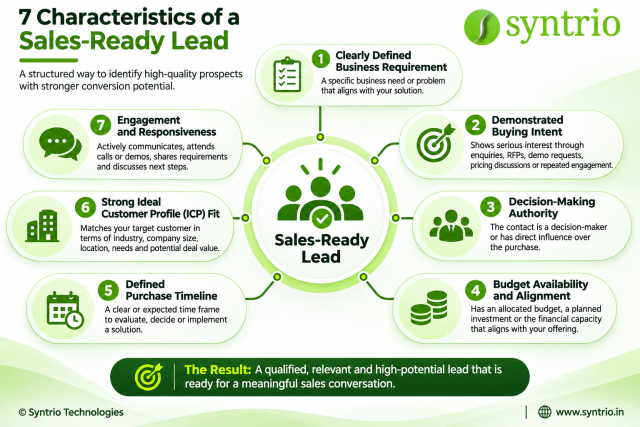
4. Seven Characteristics of a Sales-Ready Lead
Identifying sales-ready leads requires more than checking whether a prospect has submitted an enquiry or responded to a marketing campaign. Businesses need to evaluate multiple factors to understand whether a potential customer represents a genuine sales opportunity.
A structured qualification process helps sales teams prioritise prospects, reduce time spent on unproductive conversations and focus on opportunities with stronger conversion potential.
Here are seven key characteristics that define a sales-ready lead.
1. Clearly Defined Business Requirement
A sales-ready lead has a specific business problem, requirement or objective that aligns with the solution being offered.
For example, a company looking for cloud migration, cybersecurity improvements or IT infrastructure management has a more identifiable requirement than an organisation that has simply expressed general interest in technology services.
2. Demonstrated Buying Intent
Buying intent indicates how seriously a prospect is considering a product or service. This can be identified through direct enquiries, requests for proposals, demo requests, pricing discussions or repeated engagement with relevant business content.
The stronger the buying signals, the more relevant the opportunity for sales engagement.
3. Decision-Making Authority
Connecting with the right person is essential in B2B sales. A lead may have a genuine business requirement, but if the contact has no influence over purchasing decisions, the sales process may take longer.
Identifying decision-makers, department heads, procurement teams and key influencers helps businesses navigate the purchasing process effectively.
4. Budget Availability and Alignment
A prospect’s budget plays an important role in determining whether an opportunity is commercially viable.
Sales teams should understand whether the organisation has an allocated budget, is planning an investment or has the financial capacity to consider the proposed solution.
The objective is to ensure that the offering and the prospect’s investment expectations are reasonably aligned.
5. Defined Purchase Timeline
Understanding when a prospect intends to make a purchasing decision helps sales teams prioritise opportunities.
A company planning to implement a solution within the next quarter may require immediate engagement, while a prospect exploring options for the next financial year may need continued nurturing.
A clear timeline makes sales forecasting and follow-up planning more effective.
6. Strong Ideal Customer Profile (ICP) Fit
Not every interested prospect is necessarily the right customer. A sales-ready lead should match the organisation’s Ideal Customer Profile (ICP).
Important parameters include:
- Industry and business segment
- Company size and annual revenue
- Geographic location
- Technology requirements
- Business challenges
- Potential deal value
A strong ICP match increases the likelihood that the prospect will benefit from the offering and become a long-term customer.
7. Engagement and Responsiveness
A prospect’s willingness to communicate provides valuable insight into their readiness.
Responding to emails, participating in discovery calls, sharing business requirements, attending product demonstrations and discussing next steps are all positive engagement signals.
Consistent engagement helps sales teams understand the prospect’s expectations and determine the appropriate next action.
Bringing These Seven Characteristics Together
A high-quality sales-ready lead is not defined by a single qualification parameter. It is the combination of business need, buying intent, decision-making access, budget alignment, purchase timeline, customer fit and engagement that determines its overall sales potential.
Businesses should establish a consistent lead qualification framework and assign appropriate priority to each parameter rather than relying on assumptions or basic contact information.
The ultimate goal is to ensure that every lead passed to the sales team has sufficient information, relevance and potential to justify meaningful sales engagement.
5. How to Build a Pipeline of Sales-Ready Leads
Building a consistent pipeline of sales-ready leads requires a structured approach that combines market research, accurate prospect data, targeted outreach and systematic lead qualification. Simply generating contact lists or running advertising campaigns is not enough. Businesses need a repeatable process to identify the right prospects, engage decision-makers and convert potential interest into genuine sales opportunities.
Here are six practical steps to build a high-quality B2B sales pipeline.
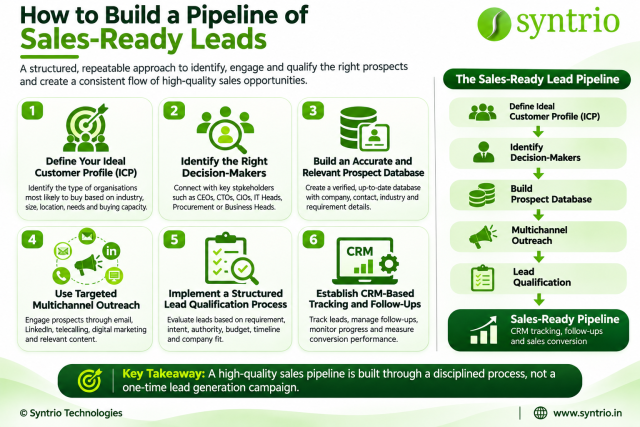
1. Define Your Ideal Customer Profile (ICP)
Start by identifying the type of organisations most likely to purchase your products or services. A clearly defined Ideal Customer Profile helps businesses avoid targeting irrelevant prospects.
Consider parameters such as:
- Industry and business segment
- Company size and annual revenue
- Geographic location and target market
- Technology requirements
- Business challenges and operational needs
- Potential purchasing capacity
A well-defined ICP creates a foundation for all subsequent lead generation activities.
2. Identify the Right Decision-Makers
Generating leads at the company level is not enough. Businesses must identify the individuals responsible for evaluating, recommending or approving purchasing decisions.
Depending on the solution, these may include CEOs, CTOs, CIOs, IT Heads, Procurement Heads, Marketing Directors or Business Development Heads.
Identifying the right stakeholders improves the relevance of outreach and reduces the time spent navigating the wrong contacts.
3. Build an Accurate and Relevant Prospect Database
A high-quality sales pipeline begins with reliable prospect information. Businesses should build databases using relevant industry sources, company websites, professional networks, business directories and verified data providers.
Important data points include:
- Company name and website
- Industry and company size
- Contact person’s name and designation
- Verified business email address
- Contact number
- Location
- Relevant business requirements or potential opportunities
Regular data validation is equally important to minimise outdated contacts, incorrect information and duplicate records.
4. Use Targeted Multichannel Outreach
Once the prospect database is ready, businesses need a structured engagement strategy to reach potential customers.
A combination of channels can improve visibility and engagement, including:
- Email Marketing: Personalised emails highlighting relevant business challenges and solutions.
- LinkedIn Outreach: Connecting with decision-makers and initiating industry-specific conversations.
- Telecalling: Direct conversations to understand business requirements and identify potential opportunities.
- Digital Marketing: Targeted campaigns to attract prospects actively searching for relevant solutions.
- Content Marketing: Blogs, case studies, whitepapers and industry insights that build credibility and encourage enquiries.
The objective is not simply to increase outreach volume but to initiate relevant conversations with the right audience.
5. Implement a Structured Lead Qualification Process
Every response or enquiry should go through a qualification process before being passed to the sales team.
Evaluate prospects based on:
- Business requirement and solution fit
- Buying intent and level of interest
- Decision-making authority
- Budget availability
- Expected purchase timeline
- Company profile and potential deal value
A structured qualification framework ensures that sales teams receive relevant opportunities rather than unfiltered contact lists.
6. Establish CRM-Based Tracking and Follow-Ups
A sales pipeline requires continuous monitoring. Businesses should use a CRM system to track lead sources, communication history, qualification status, follow-up dates and sales progress.
A well-maintained CRM helps teams:
- Track every lead from generation to conversion.
- Assign ownership to sales representatives.
- Schedule timely follow-ups.
- Monitor lead ageing and engagement.
- Identify conversion bottlenecks.
- Measure campaign and sales performance.
Consistent follow-ups are particularly important because many B2B purchasing decisions involve multiple stakeholders and longer evaluation cycles.
6. Lead Qualification Frameworks That Work
Generating leads is only one part of the sales process. Businesses also need a consistent method to evaluate prospects and determine which opportunities deserve immediate attention.
Lead qualification frameworks provide a structured way to assess potential customers based on their business requirements, purchasing capacity, decision-making authority and buying intent.
Instead of relying on assumptions or subjective sales judgments, these frameworks help sales teams follow a repeatable qualification process.
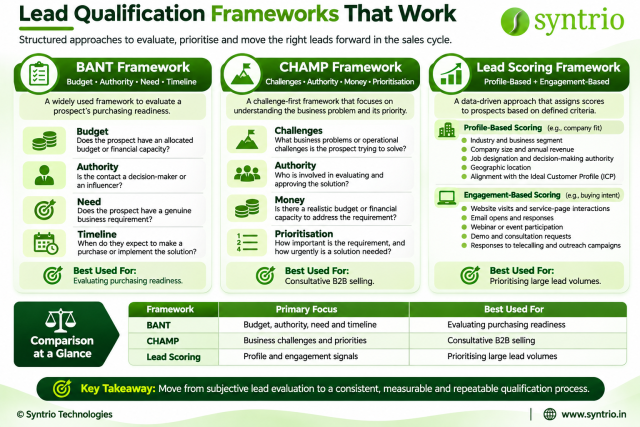
Here are three commonly used approaches for qualifying B2B leads.
1. BANT Framework (Budget, Authority, Need and Timeline)
BANT is one of the widely recognised lead qualification frameworks used in B2B sales. It evaluates prospects across four important parameters.
- Budget: Does the prospect have an allocated budget or the financial capacity to purchase the solution?
- Authority: Is the contact a decision-maker or someone who influences the purchasing decision?
- Need: Does the prospect have a genuine business problem that your product or service can address?
- Timeline: When does the prospect expect to make a purchasing decision or implement the solution?
Example: A company looking for cloud infrastructure management services, with an identified IT requirement, an approved budget, an involved technology head and a three-month implementation timeline, would be a strong candidate for further sales engagement.
2. CHAMP Framework (Challenges, Authority, Money and Prioritisation)
CHAMP takes a challenge-first approach to lead qualification. Rather than beginning with the prospect’s budget, it focuses on understanding the business challenges that create the need for a solution.
Its four components include:
- Challenges: What business problems or operational challenges is the prospect trying to solve?
- Authority: Who is involved in evaluating and approving the solution?
- Money: Is there a realistic budget or financial capacity to address the requirement?
- Prioritisation: How important is the requirement, and how urgently does the organisation need a solution?
Example: An organisation experiencing rising cloud infrastructure costs may be actively exploring optimisation services. If the issue is a business priority and the relevant decision-makers are involved, the opportunity deserves closer sales attention.
3. Lead Scoring Framework
Lead scoring assigns numerical values to prospects based on predefined characteristics and engagement activities. It helps businesses prioritise leads according to their potential sales value.
A lead scoring model can consider two broad categories:
A. Profile-Based Scoring
- Industry and business segment
- Company size and annual revenue
- Job designation and decision-making authority
- Geographic location
- Alignment with the Ideal Customer Profile (ICP)
B. Engagement-Based Scoring
- Website visits and service-page interactions
- Email opens and responses
- Webinar or event participation
- Demo and consultation requests
- Responses to telecalling and outreach campaigns
For example, a business may assign higher scores to prospects who match its ICP, hold relevant decision-making positions and have requested a product demonstration.
The cumulative score can then be used to categorise prospects into high-, medium- and low-priority segments.
Comparison of Lead Qualification Frameworks
| Framework | Primary Focus | Best Used For |
|---|---|---|
| BANT | Budget, authority, need and timeline | Evaluating purchasing readiness |
| CHAMP | Business challenges and priorities | Consultative B2B selling |
| Lead Scoring | Profile and engagement signals | Prioritising large lead volumes |
Which Framework Should Businesses Choose?
There is no single framework that works for every organisation.
BANT is useful when businesses need to assess purchasing readiness. CHAMP is particularly relevant when understanding business challenges is central to the sales conversation. Lead scoring is effective when organisations manage large prospect databases and need to prioritise sales engagement.
Many businesses combine these approaches to create a more comprehensive qualification process. For example, lead scoring can identify high-priority prospects, while BANT or CHAMP can be used during discovery calls to evaluate their actual requirements.
The objective is to move from subjective lead evaluation to a consistent, measurable and repeatable qualification process.
7. How AI and Automation Improve Lead Qualification
Traditional lead qualification often depends on manual research, spreadsheets, telecalling and individual sales judgement. While these methods can work for smaller operations, managing large volumes of prospects across multiple industries and markets becomes increasingly difficult.
This is where Artificial Intelligence (AI) and automation are transforming modern lead generation and qualification processes.
AI-powered systems can analyse prospect information, identify buying signals, evaluate engagement patterns and prioritise leads based on predefined qualification parameters. Combined with automation, these capabilities help businesses reduce manual effort, improve response times and create a more consistent sales pipeline.
Here are six ways AI and automation can improve lead qualification.
1. Automated Prospect Research and Data Enrichment
AI-powered tools can help collect, organise and enrich prospect information from relevant business data sources.
They can assist in identifying:
- Company profile, industry and business size
- Decision-makers and relevant job designations
- Business contact information
- Technology requirements and service relevance
- Potential business opportunities
This reduces the time spent on manual research and helps sales teams work with more complete prospect profiles.
2. AI-Based Lead Scoring and Prioritisation
Traditional lead scoring often relies on manually assigned points. AI-based lead scoring can go further by analysing multiple data points, historical conversion patterns and prospect engagement.
For example, an AI system can evaluate a prospect’s company profile, website interactions, email responses, enquiry history and buying signals to estimate its sales potential.
Leads can then be categorised into high-, medium- and low-priority segments, helping sales teams focus on the most relevant opportunities.
3. AI-Powered Intent and Behaviour Analysis
AI can analyse prospect behaviour to identify potential buying intent.
Signals may include:
- Repeated visits to product or service pages
- Requests for pricing or product demonstrations
- Engagement with specific marketing campaigns
- Responses to email and LinkedIn outreach
- Enquiries related to specific business requirements
When multiple signals indicate stronger interest, the system can flag the prospect for timely sales engagement.
4. Automated Email and Multichannel Follow-Ups
One of the biggest challenges in B2B sales is maintaining consistent follow-ups.
Marketing automation platforms can schedule personalised email sequences, reminders and engagement workflows based on prospect behaviour.
For example, when a prospect downloads a service brochure but does not respond to the initial communication, an automated follow-up sequence can provide relevant information and encourage further engagement.
This helps maintain communication without requiring sales representatives to manually track every interaction.
5. AI Voice Agents for Initial Lead Qualification
AI-powered voice agents can automate initial prospect conversations through inbound and outbound calling.
These agents can:
- Introduce the business and its offerings.
- Ask predefined qualification questions.
- Understand basic business requirements.
- Capture responses and prospect preferences.
- Identify interest and potential buying timelines.
- Schedule follow-up calls or transfer qualified prospects to sales representatives.
This can be particularly useful for businesses managing large lead volumes, where manually contacting every prospect requires significant time and resources.
6. CRM Integration and Intelligent Lead Routing
AI and automation become more effective when integrated with a Customer Relationship Management (CRM) system.
Once a lead is generated and qualified, automated workflows can update its information, assign a qualification score, identify the relevant sales representative and schedule the next follow-up.
This creates better visibility across the sales process and reduces the possibility of leads being missed or left unattended.
How AI Improves the Lead Qualification Process
AI can support the entire journey, from prospect identification to sales handover:
Prospect Data Collection → AI-Based Research → Lead Scoring → Intent Analysis → Automated Engagement → Qualification → CRM Assignment → Sales Team
The Business Impact
When implemented effectively, AI and automation can help businesses:
- Reduce manual lead research and qualification effort.
- Improve lead prioritisation.
- Respond to prospects faster.
- Maintain consistent follow-up communication.
- Improve visibility into prospect engagement.
- Scale lead qualification without proportionately increasing manual workload.
AI should complement, not completely replace, human sales judgement. Complex requirements, commercial negotiations and final purchasing decisions still benefit from direct engagement with experienced sales professionals.
The real advantage of AI-driven lead qualification is the ability to process more information, identify stronger opportunities and help sales teams spend more time converting prospects into customers.
8. Common Mistakes That Damage Lead Quality
Generating a high volume of leads does not guarantee business growth. Many organisations invest in marketing campaigns, prospect databases and sales outreach but struggle to convert leads into actual customers.
In many cases, the problem lies in how leads are identified, targeted, qualified and managed. Even a well-designed lead generation campaign can produce poor results if the underlying process is not structured properly.
Here are seven common mistakes businesses should avoid when building a pipeline of sales-ready leads.
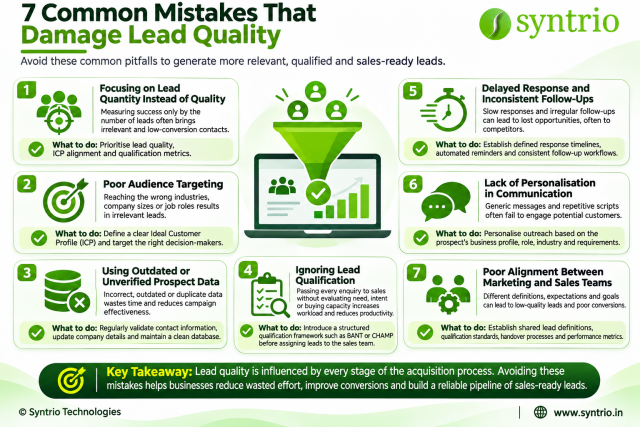
1. Focusing on Lead Quantity Instead of Quality
One of the most common mistakes is measuring lead generation success purely by the number of contacts or enquiries generated.
A campaign generating 500 unqualified leads may deliver less business value than one generating 50 relevant prospects with genuine buying intent.
What to do: Prioritise lead quality, ICP alignment and qualification metrics instead of focusing exclusively on lead volume.
2. Poor Audience Targeting
Targeting the wrong industries, company sizes, geographical markets or job designations results in irrelevant leads.
For example, approaching junior employees when the offering requires approval from a CTO, CIO or procurement head can significantly slow down the sales process.
What to do: Define a clear Ideal Customer Profile (ICP) and identify the right decision-makers before launching campaigns.
3. Using Outdated or Unverified Prospect Data
Incorrect email addresses, disconnected phone numbers, outdated designations and duplicate records reduce campaign effectiveness.
Poor-quality data also wastes telecalling resources and negatively impacts email outreach performance.
What to do: Regularly validate contact information, update company details and maintain a clean prospect database.
4. Ignoring Lead Qualification
Passing every enquiry directly to the sales team without evaluating its business requirement, buying intent or purchasing capacity creates unnecessary workload.
Sales representatives may spend considerable time pursuing prospects who are not suitable customers.
What to do: Introduce a structured qualification framework such as BANT or CHAMP before assigning leads to sales teams.
5. Delayed Response and Inconsistent Follow-Ups
A prospect who has shown interest may approach competitors if the business takes too long to respond.
Similarly, inconsistent follow-ups can result in promising opportunities being lost during the evaluation process.
What to do: Establish defined response timelines, automated reminders and consistent follow-up workflows through CRM systems.
6. Lack of Personalisation in Communication
Generic emails, repetitive calling scripts and irrelevant marketing messages often fail to engage potential customers.
B2B buyers are more likely to respond when communication addresses their specific industry, business challenges and requirements.
What to do: Personalise outreach based on the prospect’s business profile, role, industry and potential requirements.
7. Poor Alignment Between Marketing and Sales Teams
Marketing teams are often measured on the number of leads generated, while sales teams focus on revenue and conversions. Without common qualification criteria, both teams may have different expectations of what constitutes a good lead.
This creates disagreements over lead quality, ownership and conversion performance.
What to do: Establish shared lead definitions, qualification standards, handover processes and performance metrics between marketing and sales teams.
Key Takeaway
Lead quality is influenced by every stage of the acquisition process, from audience targeting and prospect research to qualification and follow-up.
Avoiding these common mistakes helps businesses reduce wasted sales effort, improve conversion opportunities and build a more reliable pipeline of sales-ready leads.
9. Measuring the Success of Your Sales-Ready Lead Pipeline
Building a pipeline of sales-ready leads is only valuable when it delivers measurable business outcomes. Businesses need to evaluate not just how many leads they generate, but also how effectively those leads progress through the sales funnel and contribute to revenue.
Tracking the right Key Performance Indicators (KPIs) helps marketing and sales teams identify performance gaps, optimise campaigns and improve the overall lead generation strategy.
Here are seven important metrics businesses should monitor.
1. Lead-to-Sales Qualified Lead (SQL) Conversion Rate
This metric measures the percentage of generated leads that successfully meet the organisation’s sales qualification criteria.
It helps evaluate whether marketing campaigns are attracting prospects who match the target audience and have relevant business requirements.
Formula:
Lead-to-SQL Conversion Rate = (Number of SQLs ÷ Total Leads) × 100
2. Sales-Ready Lead Conversion Rate
This measures the percentage of qualified leads that meet the defined sales-readiness criteria.
A higher conversion rate indicates that prospect targeting and qualification processes are identifying relevant business opportunities.
Formula:
Sales-Ready Lead Rate = (Number of Sales-Ready Leads ÷ Total Leads) × 100
3. Lead-to-Opportunity Conversion Rate
Not every sales-ready lead becomes a sales opportunity. This metric tracks how many qualified prospects progress into genuine opportunities within the sales pipeline.
It helps businesses evaluate the effectiveness of discovery calls, requirement assessments and initial sales conversations.
Formula:
Lead-to-Opportunity Conversion Rate = (Number of Sales Opportunities ÷ Total Leads) × 100
4. Lead Response Time
Lead response time measures how quickly the sales team contacts a prospect after an enquiry or a positive buying signal.
Delayed responses can reduce engagement opportunities, particularly when prospects are evaluating multiple service providers.
Businesses should establish internal response-time targets and monitor adherence through CRM systems.
5. Sales Pipeline Value
Pipeline value represents the estimated commercial value of opportunities currently being managed by the sales team.
Tracking this metric helps businesses understand potential future revenue and assess whether lead generation activities are creating sufficient business opportunities.
Formula:
Sales Pipeline Value = Sum of Estimated Values of Active Sales Opportunities
6. Customer Acquisition Cost (CAC)
Customer Acquisition Cost measures the average expenditure required to acquire a new customer.
It considers relevant sales and marketing expenses, including advertising, lead generation, sales personnel and campaign costs.
Formula:
CAC = Total Sales and Marketing Acquisition Costs ÷ Number of New Customers Acquired
Monitoring CAC helps businesses evaluate the commercial efficiency of their lead generation and sales processes.
7. Sales Velocity
Sales velocity measures how quickly opportunities move through the sales pipeline and generate revenue.
It considers the number of opportunities, average deal value, win rate and average sales cycle length.
Formula:
Sales Velocity = (Number of Opportunities × Average Deal Value × Win Rate) ÷ Average Sales Cycle Length
This metric helps businesses understand how efficiently their sales pipeline converts opportunities into revenue over time.
Key Sales-Ready Lead Performance Metrics at a Glance
| KPI | What It Measures |
|---|---|
| Lead-to-SQL Rate | Quality of generated leads |
| Sales-Ready Lead Rate | Qualification effectiveness |
| Lead-to-Opportunity Rate | Progression into sales opportunities |
| Lead Response Time | Speed of sales engagement |
| Pipeline Value | Potential future revenue |
| Customer Acquisition Cost | Cost of acquiring customers |
| Sales Velocity | Speed of revenue generation |
Why Consistent KPI Tracking Matters
Businesses should monitor these metrics regularly through CRM dashboards and marketing performance reports. Reviewing performance across different campaigns, industries, lead sources and sales teams helps identify which activities are generating the strongest opportunities.
For example, a campaign generating fewer leads but delivering a higher SQL conversion rate and lower customer acquisition cost may be commercially more effective than a campaign focused entirely on lead volume.
The objective is to connect lead generation performance with actual sales outcomes. A well-managed pipeline should not just generate more prospects; it should create measurable opportunities for sustainable revenue growth.
10. Conclusion: Turn Your Lead Pipeline into a Revenue Engine
Generating sales-ready leads is not simply about attracting more prospects. It is about building a structured and repeatable process that identifies the right audience, understands their business requirements, evaluates buying intent and connects qualified opportunities with the sales team.
Businesses that focus on lead quality rather than lead volume can improve sales productivity, reduce wasted marketing expenditure and create more predictable revenue opportunities.
From defining an Ideal Customer Profile (ICP) and identifying decision-makers to implementing structured qualification frameworks, AI-powered automation and CRM-based tracking, every stage plays an important role in building a high-quality sales pipeline.
As B2B markets become increasingly competitive, organisations need to combine data-driven prospecting, personalised engagement and intelligent lead qualification to stay ahead.
The key is to build a pipeline that consistently delivers the right prospects to the right salespeople at the right time.
Build a Stronger Sales Pipeline with Syntrio
At Syntrio Technologies , we help businesses strengthen their sales pipeline through structured B2B lead generation, targeted prospect research, decision-maker identification and sales process outsourcing.
Our services help organisations identify relevant prospects, improve lead qualification and create a more consistent approach to business development.
Whether you are looking to expand into new markets, reach enterprise decision-makers or improve your existing lead generation process, Syntrio can help you build a pipeline focused on meaningful business opportunities.